Ownership · 4 min read
Home Hard-Shell Chamber Installation Requirements
Prepare a home room for a hard-shell hyperbaric chamber with clearance, access, floor, power, ventilation, temperature, humidity and fire-safety checks.
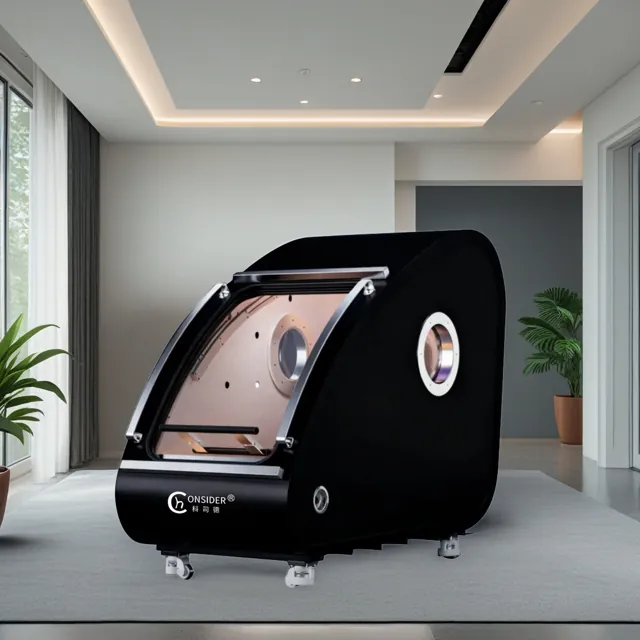
A home hard-shell chamber needs a permanent, ventilated room with enough clearance to operate and service the equipment. Before delivery, check the full route into the home, the floor, dedicated power, room conditions and fire-safety arrangements against the chamber model's requirements.
Room Size and Operating Clearance
| Check | Requirement | Why it matters |
|---|---|---|
| Chamber clearance | Leave at least 0.05 m around the chamber and 0.5 m above it. Do not place it directly against a wall. Keep the main unit at least 0.3 m from walls, with its front unobstructed. | Allows inspection, equipment service and rapid emergency access. |
| Ceiling height | At least 2.4 m. Keep space above the equipment for heat to dissipate; do not enclose it in a sealed ceiling structure. | Prevents heat buildup that can shorten component life. |
| Delivery route | Check that doors, corridors, elevators and stairways can accommodate the chamber's largest assembled or disassembled dimensions. | The rigid chamber cannot pass through an undersized route. |
| Floor | Use a firm, level floor with a slope below 2 degrees. Concrete or tile is preferred. Confirm that the floor supports the combined weight of the equipment and users. | Do not install on a suspended attic floor, lightweight flooring or foam underlay. |
| Position | Keep the chamber away from curtains, bedding and other combustible fabrics, as well as underfloor heating, radiators and portable heaters. Avoid prolonged direct sunlight. | Heat and sunlight can accelerate deterioration of seals and tubing. |
Dedicated Electrical Supply
- Provide a dedicated circuit for the chamber. Do not share it with high-power appliances such as air conditioners, water heaters or induction cookers.
- Use copper-core wiring with a dedicated circuit breaker and residual-current protection.
- Ensure the equipment is reliably grounded for protection against static and electrical leakage.
- Place a dedicated, dust- and water-protected outlet away from the chamber and any area where condensation or water may drip onto the connection.
- Do not use low-quality adapters, daisy-chained power strips or long extension leads.
Ventilation, Temperature and Humidity
| Room condition | Requirement |
|---|---|
| Ventilation | Provide natural ventilation through an opening window or mechanical exhaust. Do not use a completely sealed, windowless room for extended operation. |
| Temperature | Maintain an ambient temperature of 5–40 °C. |
| Relative humidity | Maintain relative humidity between 20% and 86%. |
Fire and Static Precautions
- Keep alcohol, perfume, aerosol sprays, lighters, paint, lithium batteries and other flammable or explosive items out of the room.
- Keep open flames away from the operating area at all times. Do not smoke, burn incense coils or use candles near the chamber.
- Reduce static-prone synthetic carpets and curtains. Cotton fabrics and ceramic furnishings are preferred in the source document.
- A dry-powder fire extinguisher is recommended for the room.
Rooms and Locations to Avoid
- Kitchens, bathrooms, shower rooms and areas that are damp or prone to standing water.
- Sealed basements or storage rooms without ventilation and natural light.
- Attics, mezzanines, rooms with lightweight partitions or other locations with insufficient floor capacity.
- Rooms used to store chemicals, oil, gas or paint and solvent vapors.
- Locations immediately beside high-power heating equipment or other high-temperature sources.
Before Delivery
- Measure every doorway, corridor, stairway and elevator on the delivery route, including turns and the final room entrance.
- Confirm the chamber's transport dimensions, installed footprint, total weight, electrical supply and service clearances for the specific model.
- Prepare the dedicated circuit, grounding, ventilation and room conditions before scheduling installation.
Do not self-use the chamber with cold-related nasal congestion, otitis media, pneumothorax, severe hypertension or a high-risk pregnancy. Follow the operating instructions supplied for the specific model.
Compare fixed and portable home systems in home hard-shell vs soft-shell mHBOT, or review the home chamber operating guide.
Have a Question About Your Project?
Our team can recommend the right chamber for your market, space and pressure.